Oshiomhole, Sowore, Onyeagocha clash over Nigeria’s democracy at Oroh’s book launch

Oshiomhole, Sowore, Onyeagocha clash over Nigeria’s democracy at Oroh’s book launch
By Idun Maximus
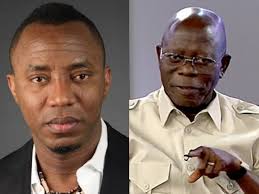
Prominent Nigerians including Senator representing Edo North, Adams Oshiomhole, former House of Representatives member, Uche Onyeagocha and activist Omoyele Sowore on Thursday clashed at the launch of Senator Abdul Oroh’s new book, “Demonstration of Craze: Struggles and Transition to Democracy in Nigeria”.
The three prominent Nigerians among others sharply disagreed over the state and progress of Nigeria’s democracy since 1999.
Omoyele Sowore, who is a two-time presidential candidate of the African Action Congress (AAC), delivered a scathing assessment of Nigeria’s democratic journey and argued that the transition to democracy was hijacked by “charlatans” who have since monopolized power.
He said: “There was a mistake we must admit to that we made when democracy came about in 1999. In all fairness, we shouldn’t have allowed charlatans to hijack the democratic process; we did. And we are guilty of where we are today.”
Sowore contrasted Nigeria’s democracy with that of the United States and South Africa, stressing the failure to protect fundamental rights. “Abdul’s book title refers to democracy as ‘demonstration of craze’. But I have always referred to Nigerian democracy as ‘morontocracy’, a democracy hijacked by morons, and that is the result you can get”, he said.
He lamented ongoing persecution of civil rights activists under the current government, saying, “the government of the day still persecutes us because there is no structure to guarantee fundamental human rights and well-being.”
Sowore also warned about the 2027 elections, describing recent polls as mere “selection” processes rigged by security agencies.
“I ran for election twice but only saw on election day a selection. Whoever you see in INEC today is most likely an APC card-carrying member. The biggest people who rig elections in Nigeria are in the military, the security services”, he said.
He recounted his experience in the DSS during the 2019 Kogi election: “They emptied the place; the only people left were guarding me and the gate. Everyone else went to rig the election for Yahaya Bello. That will continue to happen”, he said.
Uche Onyeagocha, former member of the House of Representatives and civil liberties advocate, provided a nuanced critique of the early pro-democracy movement’s political engagement, saying most of those who came out of the student movement populated the civil liberties organization and the pro-democracy movement.
He regretted that unfortunately, in 1999, after a very difficult meeting in Port Harcourt, the majority decision was that they would not participate in the political process.
Onyeagocha explained the consequences of that decision. He said: “Following that decision not to participate, the space that they would have occupied was filled by all manner of people, and these people have continued to determine who enters and who gets thrown out of the political space in what we call today’s Nigerian democracy.”
He expressed deep disappointment with the ruling parties: “What we have today as APC is a bunch of brigands and bandits. The same characters who were in PDP crossed over and took over APC.”
Onyeagocha recalled his own experience opposing authoritarian moves, saying, “When Obasanjo wanted to impose a state of emergency in Plateau State, I, as a member of APGA, led the opposition on the floor. We challenged the move, saying you cannot impose a state of emergency without proper dissenting voices.”
He lamented the lack of dissent in today’s political environment: “Today, the APC you talk about is populated by the same brigands who cross over from PDP. There is no meaningful opposition or dissent.”
On the state of Nigeria’s democracy, Onyeagocha was blunt: “When you talk about ‘demonstration of craze’ as the title of this book, I think it captures the pitiful sight that our democracy has become.”
Adams Oshiomhole responded pointedly to both Omoyele Sowore’s sharp critique of Nigeria’s democracy and Uche Onyeagocha’s reflections on political disengagement.
Addressing Sowore’s claim that pro-democracy activists made a mistake by not contesting elections in 1999, Oshiomhole said: “It is this same cynicism, doubt, dismissal, sweeping generalisation that misled some who struggled for democracy to say nothing good can come out of the military. They don’t mean it. There would be no election; a rat cannot give birth to a rabbit.
“There were all kinds of stories. How can the military midwife real democracy? No, it is not possible, because it’s always better to dismiss everything to get louder applause.”
He explained how such dismissal created a vacuum exploited by those who captured power, adding, “the bad guys decided, since you guys who fight keep dismissing those who were in charge of the system you want to change, we will go in there. They went in, captured power, changed the culture of power, and changed the rules of the game.”
Oshiomhole cautioned against despair: “When you dismiss in a very sweeping manner that the country is hopeless, the system is impossible, should we begin to cry? No. The gap between where we think we ought to be and where we are should be enough incentive for us not to give up on ourselves.”
Turning to Onyeagocha’s critique of the political space being filled by “all manner of people” after pro-democracy activists’ withdrawal, Oshiomhole acknowledged the complexity but urged unity.
“We must have space for contestation, bitter contestation. I can be wrong, you can be wrong, but no one has monopoly of wisdom. We share a commitment about the direction”, he said.
He stressed the need for hope and collective effort, saying leaders must not discourage people from believing there is a future, adding that the past and present are imperfect, but that should inspire the people to keep striving for better.
He reminded the audience that progress requires collective effort and cautioned against sweeping generalizations that undermine the struggle.
Ayo Obe, a veteran human rights activist, set the tone by reflecting on the legacy of Nigeria’s struggle for democracy. She lamented the current trend of glorifying dictators and warned against complacency.
She said: “If we don’t take a stand and have a say for ourselves, people cannot see the difference between democracy and dictatorship, no matter how much propaganda one may deploy. The struggle had to be for the end of military dictatorship, but it’s not the same people who fought for independence who should still be fighting to improve or develop our democracy.”
Obe emphasized the importance of passing the baton to younger generations who understand the stakes.
“We need a conveyor belt of people who know what they are struggling for because if we keep expecting the old generation to lead, we will miss the moment”, she said.
Obe also criticized petty political squabbles that detract from the common good, saying, “some of the petty things we indulge in are quite frankly irritating. We need to get over ourselves and work for the common good.”
Minister for Niger Delta Development Commission, activists and former lawmaker, Abubakar Momoh challenged the notion that human rights activists avoided political participation in Nigeria’s early democracy.
“Have we forgotten that Gani Fawehinmi had a party in 1999, the National Conscience Party, and was a presidential candidate? Some of us in the labour movement didn’t even vote for him.”
He urged activists to engage politically from the grassroots and noted: “If you are serious about involvement, why not start from where you can get something easily? I was a councillor contesting elections and then became a local government chairman before moving to the National Assembly.”
Momoh praised Oshiomhole’s leadership in the labour movement and as Edo State governor,
“For eight years, Oshiomhole brought meaningful progress to Edo State. There is nobody from Edo who will say otherwise”, he said.
Environmental activist, Nimmo Bassey highlighted the critical link between environmental degradation and human rights.
He said: “Nigeria’s environment is so badly damaged that life expectancy is drastically reduced, especially in the Niger Delta where it is only 41 years.”
He praised the CLO’s role in environmental activism and urged vigilance.