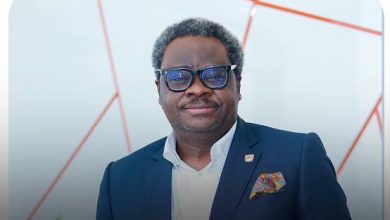
Mbah pushes for South East Common Market, Economic Bloc, says zone can’t afford to operate as five parallel actors
*Commends establishment of SEDC as catalyst for regional development


Governor of Enugu State, Dr. Peter Mbah has said that the South East must be reimagined and built into a common market and economic bloc in order to realise its potential as an economic power-house.
Mbah emphasised that the South East could no longer afford to operate as five parallel States.
He commended President Bola Tinubu for the establishment of the South East Development Commission (SEDC), a clear demonstration of an understanding that regional development does not occur in isolation.
Mbah made the case earlier today – Wednesday, February 4 – in Enugu, the Enugu State capital, as the Vice President, Senator Kashim Shettima, officially declared open the South East Vision 2025 (SEV2025) Regional Stakeholder Forum at the International Conference Centre, ICC, Enugu.
“I am here to invite you to a bold re-imagining of the South East as a single economic bloc. For too long, we have looked at our five states as individual islands, but the era of the solitary path is over.
“Today, I propose the birth of the South East Common Market – a bold, borderless unification of our commerce, our talent, and our industrial grit.
“By fusing our five distinct economies into one powerhouse, we are no longer just negotiating for a seat at the table; we are building the table ourselves.
“This is more than a policy shift; it is the awakening of an economic giant, transforming the South East into a single, seamless theatre of enterprise where our shared heritage fuels our collective prosperity,” he stated.
At the event themed, “Charting a Shared Path to Sustainable Prosperity for South East Nigeria,” Mbah reminded the audience that the rules of prosperity were changing globally into a new era where those who could organise themselves, integrate their markets, and build systems at scale would rise, while those who cannot, would remain consumers of other people’s added value.
He, therefore, described the South East Vision 2050 as an instrument to help the South East to solve problems that no single state alone can solve.
He, however, said the development plan must be matched with immediate action, starting with a region-wide feasibility and project preparation phase to be jointly funded and governed.
“Second, we must begin with logistics and connectivity, because economies do not integrate on paper, they integrate through movement.
“The South East needs its first deliberately designed interstate logistics corridors, road, rail, inland hubs, and multi-modal systems that allow goods, people, and services to move seamlessly across state lines.
“These are not prestige projects. They are productivity infrastructure, and they must be planned and contracted as regional assets, not state trophies.
“Third, security must be treated as regional infrastructure. Criminal networks do not respect state boundaries, and neither should our response.
“We must commit to enhanced cross regional security coordination, shared intelligence, interoperable communication, and a centralised information and response hub that allows state security architectures and federal agencies to act as one system.
“Fourth, we must align the rules of engagement, investment processes, regulatory expectations, and dispute resolution, so that the South East presents a coherent face to capital, enterprise, and its own citizens.
He regretted that a region where identity is common and where markets connect producers and buyers across distances, and where cooperation is understood as logic, and life works by collaboration still suffers fragmentation.
“That fragmentation is no longer a historical footnote. It has become a present-day constraint. The world we are operating in now is unforgiving of disconnection and lack of unity. The global economy does not reward isolated effort.
“It rewards regions that can act as systems, regions that can coordinate infrastructure, align skills with industry, move goods efficiently, mobilise capital at scale, and present a clear, credible proposition to investors and their own people,” he explained.
“What it has lacked, until now, is a shared system strong enough to hold those strengths together.
“Vision 2050 is our chance to build that system as a framework for action, not for someday, but starting now.
“In this regard, I must recognise the leadership of President Bola Ahmed Tinubu under whose watch Nigeria is witnessing a renewed emphasis on structural reform and regional balance.
“The President’s approach provides the policy space and institutional backing for the South East to plan long-term, invest smartly, and integrate effectively into national growth priorities,” Mbah concluded.