Catholic lawyers call for stronger institutions to save Nigeria’s democracy
By John Okezie
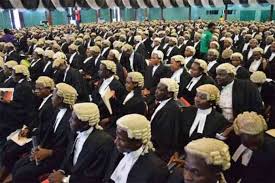
The National Association of Catholic Lawyers, Archdiocese of Lagos, penultimate week, held its national conference, the third in its series. The theme of this year’s conference was: “Strong institutions as enablers of democracy.”
In attendance were Hon. Justice Matthias Dawodu, Judge of the High Court of Lagos, Reverend Father Professor Anthony Alaba Akinwale, Vice-Chancellor of Augustine University, Ilara Epe, the Keynote Speaker, Titilola Akinlawon, SAN, Florence Atuluku, President, National Association of Catholic Lawyers, Lagos Archdiocese, Liborous Oshoma, Charles Ajiboye, Esq, Dr. Boniface Chizea, an economist, members of the executive committee, and other distinguished personalities of the legal profession.
The master of ceremonies, Almond Waive, after the introduction of personalities and panelists, including the two online panelists, Dr Chukwuemeka Ugboaja and Major General PAT Amen Vingir, introduced the first speaker, Edward Eneji Ogar, National President of the National Association of Catholic Lawyers, represented by Geraldine E. Wey, Esq.
The national president commended the Lagos Archdiocese branch for always being in the forefront in all the activities of the association, while encouraging them to keep the flag flying.
He noted that the theme for this year’s annual conference was apt, saying, “It offers members another opportunity for reflective introspection into our democratic experience; especially the political class in Nigeria that has, over time, built strong men and women, instead of strong institutions.
“They prefer to impose candidates rather than allow the people to choose whom they want to serve them.
“As we reflect on this all-important theme of the conference, I invite us all to be personally committed to the advancement of strong institutions that would strengthen the foundations of transparency, accountability and good governance.”
Florence Atuluku, President, National Association of Catholic Lawyers, Lagos Archdiocese, described this year’s annual conference as more than a tradition, a mission-driven platform for rigorous engagement with the legal, ethical and societal challenges shaping the Nigerian nation.
“It fosters dialogue, deepens our sense of professional responsibility, and promotes justice rooted in values that rise above faith and ideology.
“We convene at a pivotal juncture, one that calls for reflection, reckoning and renewed resolve. Across Nigeria and beyond, democratic systems are under strain, not only from political turbulence but, also, from the fragility of the institutions charged with upholding justice, equity and the rule of law. As legal professionals and civic- minded citizens, our duty transcends interpretation of statutes. It demands a steadfast commitment to the moral and ethical foundations upon which just societies are built,” she said.
Atuluku explained that at the heart of the association’s work is a commitment to pro bono legal service, advocating for the indigent and vulnerable, amplifying the voices of the unheard and defending the rights of those most at risk.
The association’s president went further to affirm that, when judicial, electoral, legislative and security institutions operate with integrity, transparency and accountability, they lay the foundation for governance that serves the common good.
In conclusion, she hoped that the conference deliberations would ignite a renewed commitment to institutional integrity and democratic values.
Rev. Fr. Anthony Akinwale, in his keynote address, titled “The imperative of strong institutions as enabler of democracy,” drew the attention of the audience to the definition of ‘people’ as espoused by Augustine of Hippo in his work, City of God, as the association of multitude of rational beings united by a common agreement on the object of their love.
Therefore, a nation, as an association of rational beings with shared core values, would write for themselves a constitution with a common agreement to use it and regulate their relationship as they pursue those shared core values.
He further posited that the constitution of an association establishes a government, a conglomeration of institutions that provide security for members of an association, which a nation is.
These institutions enable the government to function, so as to protect the people in the pursuit of their shared core values.
However, when a nation is exposed to the absence of a common agreement on shared values as reflected in the provisions of their constitution, as well as not using the same constitution that has provisions for protective and not oppressive institutions, then there’s no democracy in such a nation.
What, therefore, obtains in this circumstance is a state governed by a constitution decreed into existence without the consent of the people.
Its institutions ultimately would be unfriendly, disabling the governed rather than enable them to actualise their developmental potential.
The erudite professor maintained that, today, democracies are threatened and the paradox in the betrayal is that, oftentimes, enemies of democracy are democratically elected. When they assume office they turn round to use democratic means democratically to assassinate democracy.
He said, “That happens either because there are no institutions to sustain democracy or because such institutions have been weakened by strongmen and strongwomen, by their strategy and tactics in the area of public life.
It is the paradox of exercising legitimate authority illegitimately, of using what is legitimate to procure what is illegitimate.
“A land of weakened institutions is a land where reins of government are in the hands of strongmen, and absurdity is elevated to public policy. It is my contention in this presentation that where and when democratic institutions are weakened, the people are disabled, and their capacity to flourish is eroded by the whims and caprices of strong men.”
With reference to the address made to the Ghanaian parliament on July 11, 2009, by President Barack Obama, the Rev Fr. Akinwale aligned with the American President, who said, “Across Africa, we have seen countless examples of people taking control of their destiny and making change from the bottom up. We saw this in Kenya, South Africa and Zimbabwe.
“Rather, it is the young people brimming with talent, energy and hope, who are the ones who could claim the future that so many in previous generations never realised.”
“When Jerry John Rawlings died in 2020, my mind went back to the speech of Barack Obama,” said the professor. “‘Africa does not need strongmen, it needs strong institutions.’ Also, the future of Africa will not be determined by ‘giants like Nkrumah and Kenyatta.’”
Akinwale was of the opinion that Obama’s address to the Ghanaian parliament sounded like an illusion to Nkrumah and Rawlings.
“Obviously, Nkrumah fought for the independence of Ghana, became her first Prime Minister, and was a strong leader with vision. But this strongman stifled opposition and turned Ghana not into a one-party state, but into a one-man state; meaning, autocracy,” he said.
“Autocracy is the rule of one man who has succeeded in convincing or intimidating the people into believing that he has undergone an apotheosis.”
Autocracy, in Akinwale’s view, represses the democratic spirit that releases developmental energy in people. With their developmental energy released, their land becomes a habitation of persons of actualised potential.
In discussing the issue of brutality or illegitimate use of a legitimate institution in Nigeria, Rev. Fr. (Prof.) Akinwale maintained that the #EndSARS protests represented a repudiation of police and military brutality in Nigeria. But the problem was neither SARS nor the Nigeria Police. The problem was and still is, approximately, the relationship between the government and the citizen, and, ultimately, the Constitution.
The erudite keynote speaker, in furtherance to his proposition, declared: the purpose of government is to protect the rights of the citizen. The purpose of the constitution is to establish institutions, which ought to be used as instruments to protect the citizens. But there is a double jeopardy as the 1999 Constitution is weak, and this weak constitution has established weak institutions incapable of protecting citizens from the rule of the strongman. That is why successive governments in Nigeria have been accused of being at the vanguard of human rights violations. We still carry on as if we were still under military rule.
If the government is at the vanguard of human rights violation, then the police, more specifically SARS, will violate the rights of Nigerians. And, we must add, it is not just the police. Nigerians are at the mercy of government and its officials at various levels and in every institution of government, he stressed emphatically.
“Police brutality in Nigeria is a symptom of impunity by the government. In a country where impunity is paraded as governance, police brutality cannot be addressed by a presidential directive issued to the Inspector General of Police.lt is one of the many symptoms of our dysfunctional constitution. We have ended up with a hostile state because we have a hostile constitution.
“The 1999 constitution sets up Nigeria in such a way that the government is more powerful than the citizens. That is why the problem is not the police, not the judiciary, neither the legislature nor the executive arm of government, but a weak constitution that has engendered weak institutions.
“The urgent task before us is to re-envision our society, re-envision and rewrite our constitution, rediscover what it means to be a nation, and re-envision the police.
“The problem with the government of strongmen is that it is predicated on the twin principle that power is knowledge and the strong man is omniscient. Not only does he know it all, he monopolises wisdom and patriotism. He does not get into office with people’s votes, so he is not accountable to them,” he asserted.
Again, referencing the former United States president, Obama, the keynote speaker said, “When the President in his address to the Ghanaian parliament spoke of strong institutions, he listed strong parliaments; honest police force; independent judges; an independent press, a vibrant private sector; a civil society as institutions are creations of human beings, so we must be vigilant and prudent in our leadership selection process”.
In conclusion, Rev. Fr Anthony Alaba Akinwale, Vice-Chancellor of Augustine University, Ilara Epe, said, it will be of utmost importance that those who man our institutions are men and women of intellectual, administrative and ethical competence.
The two-day event was followed by the 2025 new legal year mass at the Holy Cross Cathedral Lagos.
In attendance were high court judges, Senior Advocates of Nigeria, and a host of other distinguished legal personalities.