2027: SMBLF insists on southern president, state police
By Ndukaku Ihe
A group, the Southern and Middle Belt Leaders Forum (SMBLF) has demanded that all political parties zone the 2027 presidency to Southern Nigeria, while urgently calling for state and community policing to combat the renewed state of insecurity gripping over 70 percent of Nigeria’s territory.
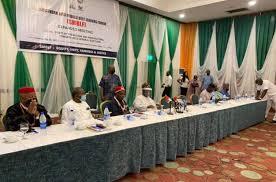
The resolutions emerged from a general meeting Tuesday at the Pan Niger Delta Forum (PANDEF) Liaison Office in Maitama, Abuja, chaired by Oba Oladipo Olaitan, leader of Afenifere and current SMBLF chairman.
Key participants included Bitrus Pogu, President of the Middle Belt Forum; John Azuta-Mbata, President-General of Ohanaeze Ndigbo Worldwide and Godknows Igali, leader of PANDEF, who read the communique to delegates and journalists.
The forum also received a delegation from the National Christian Elders’ Forum (NCEF), led by 92-year-old chairman, Samuel Gani.
Speaking on the 2027 elections, SMBLF recalled its 2021 position ahead of the 2023 polls, when it urged a Southern presidency following the eight-year tenure of the late President Muhammadu Buhari from the North.
“SMBLF thus admonished all political parties to clearly zone the position of the President of the nation to the South in the interest of national political stability, particularly that such zoning arrangement had been the trend and emerging as part of the national democratic culture since 1999”, the communique stated.
Oba Olaitan reinforced this, declaring, “Political parties now at their congresses and conventions are advised to make sure that their presidential candidates emerge from Southern Nigeria.”
AbeyaNews reports that security dominated the deliberations, with the forum expressing alarm at the level of the crisis.
“SMBLF as well as Nigerians at large are alarmed at the renewed and unabated state of insecurity in the nation. More than 70 percent of the national territorial space is ungoverned and unmanned by security personnel”, it stated.
While reiterating confidence in the Nigerian armed forces and other security institutions and their capacities to protect life, property of Nigerians and her territorial integrity, SMBLF highlighted a critical shortfall that security thrives on intelligence which is naturally local. The strength of officers under arm, particularly in terms of numbers, it said is not commensurate with the enormity of the problem.
The group demanded an immediate halt to “the so-called reintegration of deradicalised terrorists” and voiced “unapologetic solidarity with the indigenous Nigerian people who are targets of genocidal attacks,” urging them “to stand up for their collective defence by all means possible.”
As a “minimum action,” SMBLF called for constitutional amendments to enable state and community police, a position echoed by President Bola Tinubu.
“We must have state police now,” the communique insisted. To advance this, the forum announced a 12-member committee of security experts.
Olaitan warned, “The situation is so worrisome,” emphasising that decentralised policing would leverage local intelligence for faster responses in rural areas, complementing federal forces without replacing them.
On restructuring and the economy, SMBLF “insists on the restructuring of the Federation to give the federating ethnic nationalities and constituent states the required autonomy, in tandem with true federalism on which Nigeria was built by our founding fathers.”
It urged the Federal Government to make redoubled efforts to tackle the suffering of Nigerians amid global headwinds, recommending more focused support for local refineries of crude oil and clear programmes to stop importation of refined products.