
After 843 days, 12 hours, 6 minutes, Hostages Square clock goes dark with Ran Gvili’s return
*Emotional Tel Aviv ceremony, heavy with symbolism, commemorates end of digital count-up marking hostages’ time in Gaza after return of final captive’s body

Released hostage: ‘Every second could have been our last’
It ran for more than two years and three months.
It loomed over rallies, speeches, and several rounds of hostage releases.
It served as a constant reminder that, for the families of the captives held in Gaza, and for much of the country, time had effectively stopped on October 7, 2023.
Then, on Tuesday, after almost 844 days, the clock in Tel Aviv’s Hostages Square, recording every second the captives remained in Hamas’s hands, went dark at last.
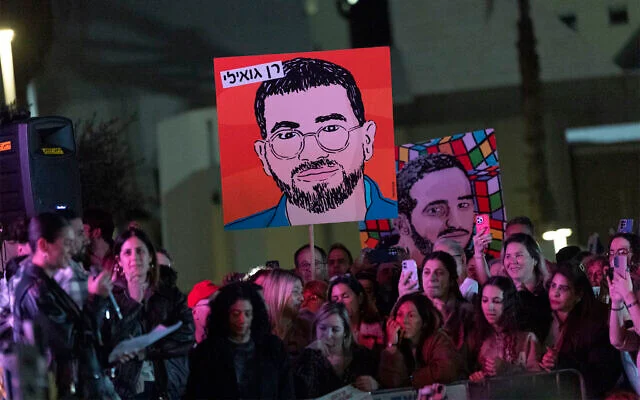
Under the fading late afternoon light, a day after the return of the final slain hostage, police Master Sgt. Ran Gvili, hundreds gathered to officially halt the clock. Installed in the square after the Hamas-led October 7, 2023, onslaught, it became one of the most recognizable emblems of the hostage families’ public struggle — a running tally of the days, hours, minutes and seconds that the captives were held in Gaza.
At the moment it shut off, the clock showed 843 days, 12 hours, five munites and 59 seconds.
Speaking to the crowd, Gvili’s sister, Shira, expressed a bittersweet sense of relief.
“On October 7, our clock stopped… Now we can really stop the clock,” she said.
“Now, I can say that Rani is here with us – Rani is home,” she told the crowd to the sound of applause.
Gvili said that today, with all of the hostages home, “Our duty as a people is to strengthen and hug one another… to cleanse [Israel of] all those who did wrong and to bring new people who will begin working on our behalf,” remarks that appeared to denigrate the current government.
Michel Illouz, the father of Guy Illouz, who was kidnapped and murdered in Hamas captivity, later took the stage alongside released hostage Yosef-Haim Ohana. He stressed the moment’s symbolism, saying that “even though I knew that my Guy was no longer with us, I fought all this time for the living hostages.”
Illouz spoke of Hostages Square as a place of refuge for families whose loved ones were held in Gaza for more than two years.
“I will never forget the warm and enveloping embrace that I received here,” he said.
But Illouz also voiced the anguish that continues to haunt him as the father of a slain hostage.
“I will never be able to stop thinking about and calculating the number of days that maybe my Guy would have come home alive, if an earlier deal had been reached,” he said, echoing a longstanding criticism from many families of hostages that the government did not take earlier opportunities to secure a deal to free the captives.
More than 100 hostages were freed in a ceasefire in November 2023. Another ceasefire in early 2025 saw dozens more released, and the final 20 living hostages, and 28 deceased ones, were released in the current ceasefire, which took effect in October 2025. Others went free between those periods, and still others were rescued in Israeli military operations.
“I will never be able to erase the image of my farewell from my Guy in Abu Kabir, when he turned as a sack of bones,” illouz added, referring to the day his son’s remains were returned to Israel for identification at the Abu Kabir forensic institute in Tel Aviv in October.
Former hostage Segev Kalfon also addressed the crowd, recalling that the first time he saw the countdown clock was through images shown to him while he was in Hamas captivity.
“It was a clock that measured the hostages’ time not only in days, but also in minutes and seconds,” he said. “That’s exactly how we felt – every minute was an eternity, every second could have been our last.”
As the ceremony unfolded, the crowd’s emotions oscillated between relief, grief, and uncertainty.
For Tzipi Lazar, a resident of Kfar Saba, attending hostage rallies and memorial events had become a ritual — a way of bearing witness to a collective trauma that she says still feels unresolved.
“I try my best to come to all the ceremonies,” Lazar told The Times of Israel. “I saw that there was a ceremony today, so I came.”
While she said the return of all the hostages brought some release of tension, she hesitated to describe the moment as joyful.
“The anger and the disappointment overshadow the happiness… I’m very worried [about the future], not for me, but for my grandchildren… they will need to fix the country,” Lazar said.
Also among the crowd were Kim and Sophie Isaacs, a mother and daughter visiting from Seattle.
“It doesn’t feel real,” said Sophie, who is spending a gap year in Israel with Young Judaea, a Zionist youth movement. “It’s a big milestone. I’m excited to now live here in the country and see how it changes.”
Kim had come to Israel to help her daughter move. Her return flight had been canceled due to a massive winter storm in the United States.
“I never expected to be here,” she said, gazing at the still-lit clock. “It’s overwhelming — just a lot to take in. To imagine that it’s been that long, and that the clock has been going for as long as it’s been going, it’s a relief.”
Shortly after 5:30 p.m., the clock froze. Less than an hour later, it was shut off completely, leaving behind a black screen — and a crowd singing “Hatikva,” Israel’s national anthem, in a moment that felt both solemn and uplifting.
Former hostage Rom Bravslavski took the stage moments later to leave the crowd with a final message.
“We now go from one war to another war, which will be much more difficult,” he said. “The war for rehabilitation.”
-Times of Israel (ToI): A Reporter’s Notebook by Stav Levaton
