NBA conference: Ezekwesili, Tunji-Ojo clash over Nigeria’s economic woes
By John Okezie
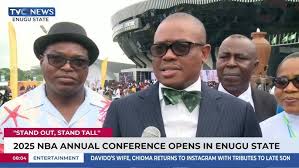
Former Minister of Education, Dr Oby Ezekwesili, and the Minister of Interior, Dr Olubunmi Tunji-Ojo, Monday, clashed over Nigeria’s economic woes at the ongoing Nigerian Bar Association (NBA) Annual Conference holding at the International Conference Centre (ICC), Enugu.
Speaking during a panel session on the state of the economy, Dr Ezekwesili said that Nigerians were right to be worried about the direction of the economy, stressing that the cost of living crisis was evidence of poor policy choices and weak governance.
She faulted Nigeria’s handling of inflation and reforms, pointing out that the middle class had been eroded under successive governments.
“In 2015, inflation stood at a single digit, about 9%. Fast forward: by the time Buhari was leaving office, it had risen to 22%, and under the same party, it climbed as high as 33%. Though in recent times, it has begun to cool down, it is still at a level where the middle class has been eroded. Suddenly, the value of your money was not what it used to be”, she said.
Ezekwesili, who also served as Minister for Solid Minerals, argued that the most critical driver of economic performance is growth, lamenting that Nigeria’s growth has slowed drastically in the past decade.
“Why did an economy that grew for nearly 12 years at an average rate of 6–7% per annum suddenly slow to 2% when Buhari left office, and only about 3% in the first quarter of this year? Compared to 6–7%, we are far from where we once were, and that should worry us—because while this stagnation is happening here, economies across the world are still growing.”
She criticised the removal of petrol subsidy as a good idea that was poorly executed. “While liberalising and moving towards market-based pricing is sound in principle, reforms of this magnitude must be planned. Otherwise, they destabilise the economy. In Nigeria’s case, the subsidy removal was a good reform done in the wrong way. Because it was poorly executed, it amplified inflationary pressures and worsened the economic burden on citizens.”
On the role of the legal profession, she added: “Our conversation on the economy is incomplete without lawyers, who form part of the elite class, reflecting on what this stagnation means for the poor. The middle class that ignores what happens to the economy is essentially setting itself up for self-destruction. Without strong institutions anchored on the rule of law, nothing else stands.”
But Minister of Interior, Olubunmi Tunji-Ojo, took a different angle, insisting that President Bola Tinubu’s administration inherited a heavily distorted economy burdened by wasteful subsidies and unsustainable debt servicing.
He said: “When we look at the economy, we must consider both where we are and where we are coming from. In 2022, the national budget was ₦17.12 trillion, with only ₦4.89 trillion allocated to capital expenditure.
“Revenue generation was ₦10.9 trillion, leaving a deficit of ₦6.92 trillion. That year, Nigeria spent ₦4.29 trillion ($10 billion) on fuel subsidy and ₦2.6 trillion ($15 billion) on forex subsidy—amounting to $25 billion on subsidies in a single year.”
He added that the situation was worsened by a debt crisis. “Debt servicing consumed 96.3% of Nigeria’s revenue in 2022, compared to 82.3% in 2021. With so much spent on debt, what was left for capital expenditure? This is the situation the current government inherited.
“While other countries invested in infrastructure to boost production, Nigeria spent on consumption. This is not a problem of two or four years—it is decades of poor choices.
“Globally, the biggest economies are also the largest spenders on research and development. Even in a law firm, a firm that fails to invest in research cannot grow beyond its capacity.
“Likewise, Nigeria has long neglected investment in infrastructure and innovation. With our population growing faster than production, the gap is widening. The solution is to massively invest in infrastructure and productivity.
“The economy is not inherently stupid, our choices and priorities have been. For too long, we promoted consumption over investment and production. Now, the task is to correct these mistakes and build an economy rooted in research, innovation, and sustainable growth,” he concluded.