

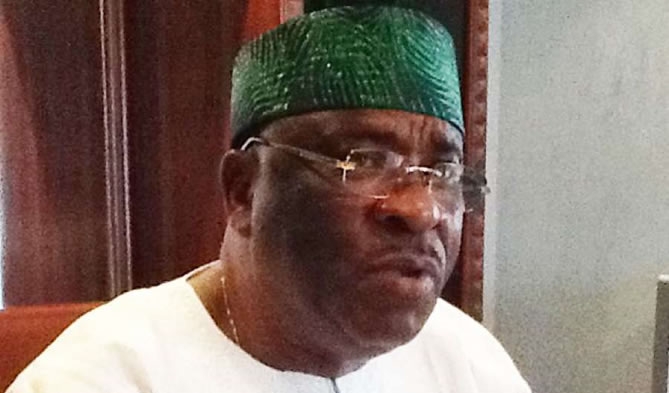
 Senator Anthony Adefuye, 81, is certainly not an Olusegun Obasanjo fan. At least, he said so himself. And while there may be a number of other reasons for this seemingly unapologetic anti-Obasanjo stance, the publicly expressed one is that he does not feel any kinship with the former Nigerian President, an Owu-Egba man from Ogun State. This is because Obasanjo, Adefuye said, is not a Yoruba man!
In an on December 23, 2020, Adefuye, a defunct SDP Senator who represented Lagos East Senatorial Zone (the same period President Tinubu represented Lagos West) in the botched Third Republic (5 December 1992 – 17 November 1993) NASS, stunned the nation when he claimed that Obasanjo is not a Yoruba man but an Igbo man from Anambra State.
“Obasanjo is an Igbo man from Anambra State; we haven’t had a Yoruba president,” Adefuye was quoted as saying, to the consternation of many who read his comment in the press or watched the controversial outing on TV.
Essentially, Adefuye was making a case for another Yoruba president to succeed immediate past President Muhammadu Buhari, barely 16 years after Obasanjo’s 1999-2007 Presidency.
Although the former President promptly dismissed the claim as unfounded, it was to become the pivot around which Adefuye and company built the false narrative that the South West was yet to produce a president in the current dispensation, a reason for the marshaling of deadly forces by the Tinubu camp, to win the 2023 presidency, either by hook or crook. According to Obasanjo, in a comment on his book titled ‘My Watch Volume 2: Political and Public Affairs, on December 28, 2020, barely five days after Adefuye made his outlandish claim, his two parents were from Owu-Egba in Abeokuta, Ogun State.
“My two parents are from Abeokuta, I bear Owu tribal marks,” Obasanjo was to declare, effectively countering the Igbo ancestry claim. Also, about August last year, Obasanjo directly addressed the controversy when, in answer to a question, he simply quipped that “it just makes me laugh.”
But such “outrageous” denigration of the former president’s heritage was not something Afenifere, the apex Yoruba socio-cultural and political organization, found funny at all at the time.
The late former National Publicity Secretary of the Afenifere, Yinka Odumakin, was reported by a national newspaper to have taken “a swipe at Yoruba sons whom he accused of trying to join others to denigrate the heritage of the former president in a bid to advance their political interests.”
In the interview he granted a national daily, Adefuye had, among other things, said: “I believe in 2023, the APC will zone the presidential ticket to the South. When it comes to the South, then it will be narrowed down to the South West because that is the only region that has not produced the president since 1999. It has always been the North and Igbos.”
Chiding him for parroting “a twisted and perverted logic,” Odumakin had lashed out at Adefuye then, warning against the absurdity of “anyone seeking to deny the Yoruba ancestry of former President Obasanjo.”
“The South West produced Nigeria’s president in the person of Chief Olusegun Obasanjo for eight years, 1999-2007. If anyone wants to be president, he should go ahead but not use the name of the Yoruba race to push through a perverted logic to try to sell his candidacy. Chief Obasanjo is a Yoruba man.”
This piece is not about the merits and or demerits of Adefuye’s “perverted logic”, to be sure. It aims, simply, to remind us that a Yoruba did succeed Buhari, as Adefuye and company desired, and to ask whether the Tinubu Presidency, as currently constituted and run, is what Adefuye had in mind when he desperately pitched for another Yoruba presidency shortly after Obasanjo’s unbroken eight-year tenure. Is what we have today under Tinubu what Adefuye meant by a true Omoluabi presidency?
One of the hallmarks of Olusegun Obasanjo’s Presidency was its inclusiveness. If any Nigerian leader had ever run a truly pan-Nigeria government, especially under our current presidential system, that leader would most likely be Obasanjo. For one, under Obasanjo, many of the oft-shrill cries of marginalization that had dominated political talks in Nigeria over time were almost completely stilled. For another, Obasanjo, in his personal actions and pronouncements, often exuded (and exudes) the one-Nigeria spirit that gave most Nigerians a sense of belonging in his government. That, though, is not to deny the avoidable excesses of his government, including the Odi, Bayelsa State, and Zaki Biam, Benue State, massacres of 1999 and 2001, a story, certainly, for another day.
It is safe, even easy, to conclude that Senator Adefuye and others didn’t like Obasanjo, up to the extent of denying his Yoruba heritage, largely because he ran a government that did not pander to any particular group’s interests. If he was a true Yoruba in power, according to this line of argument, Obasanjo should have run a Yoruba-centric government. For “acting out of character” by running a pan-Nigeria government that did not give the Yoruba a pride of place as the “owners” of his government but “completely ignored the South West (for the eight years that he was in power),” Obasanjo didn’t need any other proof that he is not Yoruba.
With no one hearing from Adefuye since Tinubu’s ascendancy, it is to be assumed that President Tinubu, watts and all, has met the elderly Lagos senator’s definition of a Yoruba President of the Federal Republic of Nigeria. Is the unabashed “Yorubaization” (to borrow Farooq Kperogi’s coinage) of the commanding heights of the Nigerian politics and economy by Tinubu– the seizure of the judiciary, the security apparatus, the legislature, the monetary and capital markets, the oil and solid mineral sectors, telecommunications, maritime, the railways, among several others – in a 350-ethnic-group federation, what Adefuye expected Obasanjo to do but which he did not do and, therefore, had to be put down as non-Yoruba?
If Tinubu’s presidency is Adefuye’s idea of a true Omoluabi presidency, would Adefuye not, wittingly or unwittingly, be projecting the S/West as incompetent spoilers, loathe to build a nation? For, apart from the “Yorubaization” of practically all the governance structures in Nigeria, what has become even more confounding about the Tinubu presidency is its embarrassing inability to govern. To all intents and purposes, there doesn’t seem to be any governance going on here. If anything, the burgeoning insecurity in the land (witness the unbridled killings around the country); the burgeoning inflation; the burgeoning hunger; the burgeoning fiscal and political corruption; the burgeoning denudation of human rights, and the burgeoning desperation among citizens to simply flee the country at any cost, among several others, are all tell-tale signs of an incompetent team unsure of what to do to serve the purpose of government.
Senator Anthony Adefuye may be right about one thing, though: if Tinubu’s political peregrinations are any guide, an Omoluabi in power would appear to be adept, very adept indeed, only at playing politics of self-preservation through full-throttle opposition value diminution, to the detriment of governance and, by extension, mandate delivery. While many Nigerians would be hard put to point at any concrete socio-economic achievements of this government as its midterm anniversary approaches, the same Nigerians would effortlessly point out how Tinubu’s 2027 re-election politics commenced even before he was sworn in as president in May 2023, starting with the well-oiled opposition destruction effort.
It is not by any coincidence that probably the only “achievement” Tinubu would be showcasing this month, on May 29 mid-term anniversary, would be how his ruling All Progressives Congress (APC) has all but established itself as the only political party still standing in Nigeria. The sucker punches being dealt prominent opposition leaders across the country, leading to what columnist Ike Abonyi has aptly described as “the devils’ flood” into APC, were carefully planned and delivered as Tinubu’s “strategic 2027 plan.” It is as if what matters in politics and leadership is the acquisition of power for the heck of it. Pray, would Tinubu only perform as president when all his opponents crawl before him, waving a new performance magic wand that he couldn’t have waved in the past two years of unbridled power acquisition and deployment?
Nobody can deny that in the fight to terminate military rule and return the country to democratic governance in 1999, the South West played a prominent role, with Tinubu and other members and promoters of the National Democratic Coalition (NADECO) in the lead. It has also been argued that without the sacrifices made by the late Chief MKO Abiola, who won the celebrated June 12, 1993 presidential election, including paying the supreme price, democracy in Nigeria would probably not have flowered but might even have been irretrievably imperiled.
But it is, perhaps, one of the gross ironies of Nigeria that, through Tinubu, the same South West is widely perceived as remorselessly supervising the systematic killing of the same democracy it led the rest of Nigeria to wrest from the military way back. The relentless, atrocious, devil-may-care move towards a one-party Nigeria State, in a multi-ethnic and multi-cultural democracy like ours, is not only a sad commentary on President Tinubu’s democratic credentials but also on that of the South West as a whole as well. After all, the anti-democratic moves of the president are widely canonized in the South West, at least to the extent that it is not widely condemned as well.
How nice it would be to hear from Elder Statesman Anthony Adefuye. Does Tinubu’s idea approximate to his, indeed, to the collective South West’s idea of a federal Nigeria bound in love, unity and shared destiny? Why has he never said anything, in support or condemnation of what is going on? Does Adefuye still believe that Obasanjo is “Omale” Yoruba because he did not run Nigeria for the South West alone, as Tinubu is perceived by many to be doing right now?
We have a president whose country is being practically overrun by foreign Fulani invaders, who are killing and supplanting indigenous populations across Nigeria, preparatory to full-scale invasion of Christian strongholds in the country for Islamization purposes, and all the big man seems to care about is how to return as president in 2027. Security reports by his own security chiefs reportedly abound about sinister plots by foreign Fulani against Nigeria, but from the look of things, or not, President Bola Tinubu doesn’t bother with such distractions. As many are wont to offer, the president couldn’t be readier to work with and even help the invaders to grab as many territories as possible in different parts of the country, as long as their hideously powerful Nigerian sponsors would pull out the stops again to return him as president in 2027. It is all about politics and the president’s two-term ambition that is anchored on little or no first-term performance.
I am sure that in the privacy of his study or bedroom, Elder Statesman Anthony Adefuye would be fuming over Bola Tinubu’s disappointing performance as a Nigerian president of South West extraction. It is also not unlikely that he would be feeling unsettled by a possible public perception of him as an elder statesman and a Senator of the Federal Republic whose vision of a Nigeria acceptable to him and some others in his part of the country is limited only to one run by a kinsman. For, if there is any lesson to be learnt from President Tinubu’s unimpressive performance so far, a lesson that Senator Adefuye and others who, directly or indirectly, helped to bring about Tinubu’s presidency, failed or refused to learn from former President Buhari’s abysmal eight-year outing, it is that there is no road for a Nigeria where the political class constantly, not to add perennially, works to enthrone “our kin”, as against “our best”, as leaders.
So, enough of the pigeonholing of leaders: let the best run who need not be our kin. Even amid the defections and so-called elite conspiracy, it is still possible for a leader to emerge who will run Nigeria for the love of country and good of all, as a true, forward-looking, God-fearing, pan-Nigeria patriot. In spite of all the foreboding permutations and mounting odds against the prospects on the narrow path, let us all work for a leader to emerge in 2027 who is breeds away from the destructive clannish tendencies of Muhammadu Buhari and President Bola Ahmed Tinubu. Or does Senator Adefuye still believe that tribe trumps all other political calculations in a polity as diverse as ours?
